News
Our stories ... ...
Ghana - 13 June, 2025
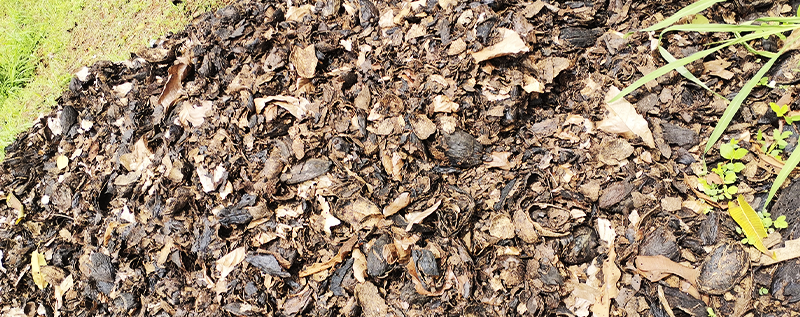
In Ghana, we support a local business that buys discarded cocoa husks from farmers and turns it into valuable compost. This creates a new source of income for farmers, while the compost helps restore soil fertility, raise cocoa yields, and build resilience to climate change.
In the northwestern region of Ghana, cocoa farming is a way of life. Yet many smallholder farmers struggle to make a sustainable living. Yields remain far below potential, due to a mix of challenges: ageing cocoa trees, extreme weather such as droughts and heavy rains, rising pest and disease pressure, and declining soil fertility. The Ghana Cocoa Board (COCOBOD) and Licensed Buying Companies offer advice and support, but most farmers lack the means to invest in essentials like farm rejuvenation or fertilizer. Without these, boosting productivity and securing a steady income remain out of reach for most farmers.
To help address these challenges, we started a partnership with EMFED Farms and Trading Company, which converts cocoa husks, often discarded as waste, into organic compost. This creates a win-win scenario: farmers can sell their cocoa husks for additional income, and in return, they receive affordable, nutrient-rich organic fertilizer to restore soil fertility. The company was founded by Kwabena Assan Mends, with the support of Solidaridad.
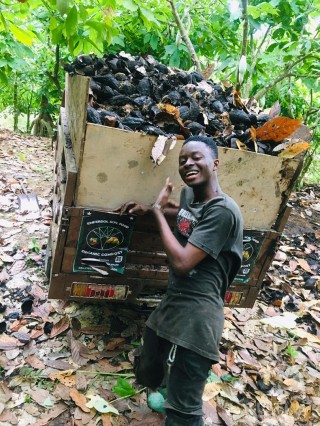
As part of the Mobilising More for Climate (MoMo4C) programme, we helped develop a business plan and set up a pilot composting line to show the benefits of using cocoa husks as compost. We are supporting the strengthening of their business and are committed to facilitating access to financing for their expansion, through a guarantee that would secure a future loan. The aim is to reach at least 1,200 farmers in the Juabeso and Bia districts of northwestern Ghana over the next five years.
The results of EMFED’s approach have been demonstrated in Central Ghana, where they helped cocoa productivity to increase from 200 kg/ha per year to over 1,200 kg/ha per year. Currently, EMFED already collaborates with a cocoa cooperative comprising 33 sub-groups and more than 1,000 members, collectively managing 1,300 hectares of cocoa farms in Bia West. By utilizing compost derived from cocoa husks, these farmers are enhancing soil health, mitigating the impacts of climate change, and fostering sustainable farming practices.
With continued support, this initiative has the potential to transform the livelihoods of thousands of cocoa farmers while promoting climate resilience. Donor contributions play a crucial role in preparing the grounds for private investments scaling up these efforts, ensuring more farmers gain access to sustainable farming inputs and economic opportunities. By investing in solutions like cocoa husk composting, the private sector directly contributes to a greener, more prosperous future for Ghanaian farming communities.
