News
Our stories ... ...
Ghana - 04 January, 2016
Over a hundred and sixty (160) tree growers in sixteen communities in Ghana have benefited from capacity building workshops organised by Tropenbos International (TBI) Ghana as part of a series of measures geared towards strengthening tree growers and their associations in Ghana.
In addition, six tree grower associations have been formed in four districts while four research studies are being carried out to find solutions to problems militating against the realisation of the full potential of tree growers and finding solutions to them.
The four research areas are: “Barriers to smallholder forest plantation development in off-reserve areas in Ghana”, “Effectiveness of incentive Systems in promoting and sustaining smallholder farmers’ interest in forest plantation development”, Assessing the integration of smallholder forest plantations into productive landscapes in the forest zones of Ghana: the case of three forest districts with contrasting forest resources” and “Options for forestry extension service delivery in landscape restoration in Ghana”.
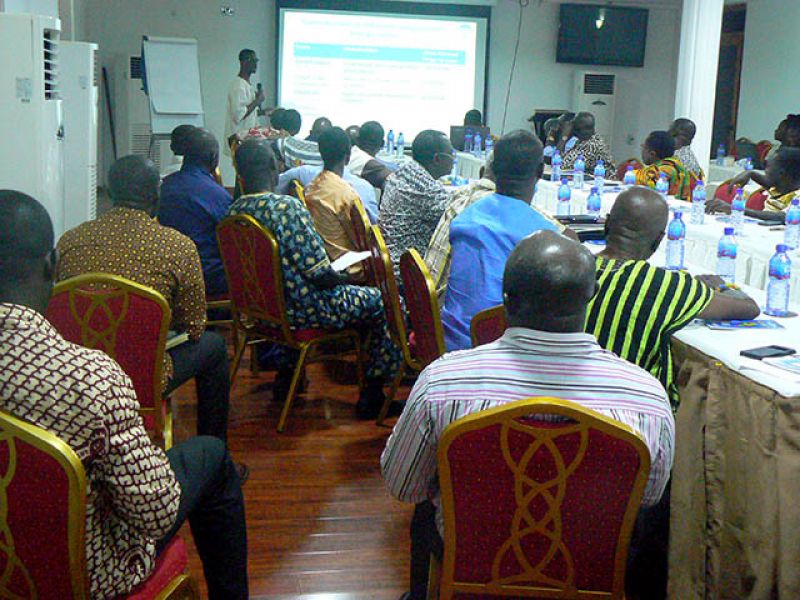
This information was presented by Mr. Kwabena Nketiah, Programme Director of TBI Ghana, to 60 participants made up of tree growers, researchers, farmers, traditional authorities, researchers, scientists and policy makers at a one-day workshop under the theme “Improving the contribution of Tree Grower Associations to forest plantation development in Ghana” in Kumasi on November 13, 2015.
These measures which are being implemented under the Landscape Restoration Project (LRP) are being carried out with the notion that smallholder tree growers and their associations are crucial to the successful implementation of the National Plantation Development Strategy as a result of their wide geographical coverage and landscape distribution.
In addition, smallholder tree growers have a positive impact on livelihoods and the environment and help retain profits from investments within the country.
Available statistics also indicates that Smallholder tree growers together contribute more to plantation development in Ghana in terms of acreage; prior to 2002, individual smallholder tree growers and their associations planted a total of 35,000 hectares of land, compared to 5,198 hectares by large scale commercial plantation developers and 4,000 hectares by the Food and Agriculture Organisation in conjunction with the Government of Ghana.
This is in spite of the fact that smallholder tree growers are scattered and operate in isolation throughout the country on small plantations with an average size of less than one hectare and often lack the necessary managerial skills to manage their plantations as a business entity effectively.
Furthermore, Smallholder tree farmers face financial and logistical constraints and hence are often at the mercy of timber contractors whilst their associations are often governed by weak structures and poor governance.
Preliminary findings from the on-going research studies being carried out by TBI Ghana indicate that there is a general lack of a well-organised technical support mechanism such as forest extension services for smallholder farmers in addition to an absence of medium-term benefits from plantations, especially after canopy closure.
Smallholder tree growers also lack good negotiation skills which makes them vulnerable to exploitation by timber contractors whilst existing co-ordination between tree grower associations and the service providers is weak.