News
Our stories ... ...
Colombia - 23 July, 2014
Through their daily practices, indigenous women have accumulated a specialized knowledge associated to agriculture, the establishment and maintenance of the chagra or conuco, the use of agrobiodiversity and the transformation and conservation of food, thus becoming the base of the family structure. Their role is fundamental in the transmission from generation to generation of agricultural knowledge that forms the base for food security and well-being of communities.
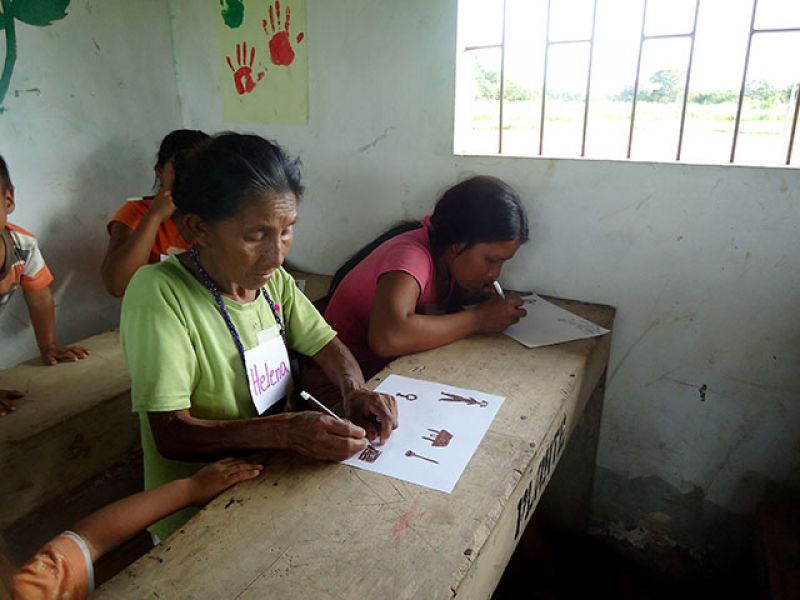
The importance of women has been taken into account to design an initiative to make visible the role of women in the indigenous communities of Laguna Colorada and Morocoto located in Selva de Matavén within the frame of sustainable productive alternatives. With this objective, Tropenbos International Colombia developed a series of meetings and workshops to generate awareness of the role of women in the provision of food, their knowledge about and proper management of agricultural resources and the activities associated to guaranteeing social well-being.
There are many obstacles to position the work of women in a productive framework. In indigenous communities, participation in local development projects is something normally performed by men; in consequence, women have not developed the same interaction capacities with different actors. On the other hand, women tend to drop out from local schools, something especially evident in Morocoto, and barely speak Spanish. In addition, the upbringing of children and the management of agricultural plots leave them very little time to get involved in capacity building and political representation activities.
Workshops in the communities in Selva de Matavén concentrated in generating a kind environment in which gestures and body language were considered valid as a form of communication and as a means to generate trust. The process helped to the incorporation a group of women in the local productive initiatives and to the recognition of their contribution to food security and agrobiodiversity in their communities. It also highlighted their participation and incidence in the sustainable use of resources and their capacity in generating fluent social dynamics. The process also allowed to recognize the joint work of women and men in the household, so that the gender component is based on respect, inclusion and complementarity.
This process with indigenous women was developed in the frame of the project “Strengthening the governance of indigenous communities in Selva de Matavén for participative decision making about the conservation of the environment and the biodiversity” in a cooperation agreement between Alexander von Humboldt Institute and Tropenbos International Colombia. This agreement forms part of the Guiana Shield initiative that includes five countries. Colombia was invited to present a pilot case in the Resguardo Unificado Selva Matavén: activities were developed between November 2013 and February 214 and were directed to strengthening the local traditional authorities organization of this indigenous resguardo has 1.8 million hectares in the area of the Vichada, Guaviare and Orinoco Rivers.