News
Our stories ... ...
Ghana - 04 January, 2016
Forests are not just an assemblage of trees, a reservoir of carbon stocks or mere items with a monetary value used for economic exchange but possess an inherent value for forest fringe communities; such values should be recognised and taken into consideration when drafting laws and policies on forest governance.
Consequently, the wellbeing of people should be the paramount determinant of every decision relating to forest management since their livelihoods and cultural heritage depend on these forests.
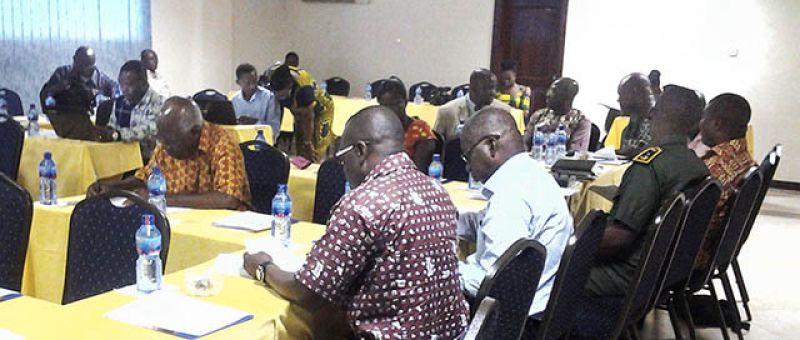
These were the views of the National Synergy Workshop organised by Tropenbos International Ghana to tease out synergies between the Forest law Enforcement, Governance and Trade / Voluntary Partnership Agreement (FLEGT/VPA) and the Reducing Emissions from Deforestation and Forest Degradation and the Role of Conservation, Sustainable Management of Forests and Enhancement of Forest Carbon Stocks (REDD+) Initiatives being implemented by the Forestry Commission (FC) as part of the measures to improve forest governance.
The workshop which took place in Accra on November 12, 2015 was attended by 50 participants drawn from both the FLEGT/VPA and REDD+ Secretariats of the FC, Civil Society Organisations (CSO’s), the Energy Commission, industry, the Timber Validation Department (TVD) and the Climate Change Unit (CCU) of the FC, Forestry Research Institute (FORIG) and people from research and academia. It was sponsored by the Food and Agriculture Organisation (FAO).
At the workshop, it was pointed out that forest resource governance as a concept focuses greatly on the human element and is therefore crucial for sustainable forest management. In addition, parallels exist between FLEGT/VPA and REDD+ that offer enormous challenges for synergy and complementarities which will eschew duplication of activities, allow for the sharing of knowledge and experience across the two initiatives, and offer a joint effort in planning and implementing action in areas of overlap.
It spelt out a series of measures for identifying Legality and Safeguards issues in Ghana under both initiatives which include; compliance with the sustainable level of timber harvests in order to safeguard the forests capacity to serve as carbon sinks, restoration of degraded forests lands to enhance forest carbon stocks and promote biodiversity conservation, and the promotion of deforestation free cocoa under which farmers would be assisted to increase cocoa production without expanding their farms.
Other measures include strategies to address chainsaw milling, instituting equitable benefit sharing arrangements under REDD+ to reduce conflicts and ensure the protection of forests, the implementation of tree tenure reforms to enable farmers derive benefits from trees on their farms, plantation development schemes by both the FC and the private sector and the promotion of alternative livelihoods by the FC with support from CSOs.
Key safeguard issues identified under Ghana’s REDD+ strategy include the need to develop environmental and social safeguards instruments, clarify tree and carbon tenure in order to develop an equitable benefit flow mechanism, mainstream gender issues into REDD+, institutionalise and sustain multi-stakeholder consultation and engagement in the sector, and implement dispute resolution mechanisms that ensure proactive prevention and management of disputes that affect the management of REDD+.